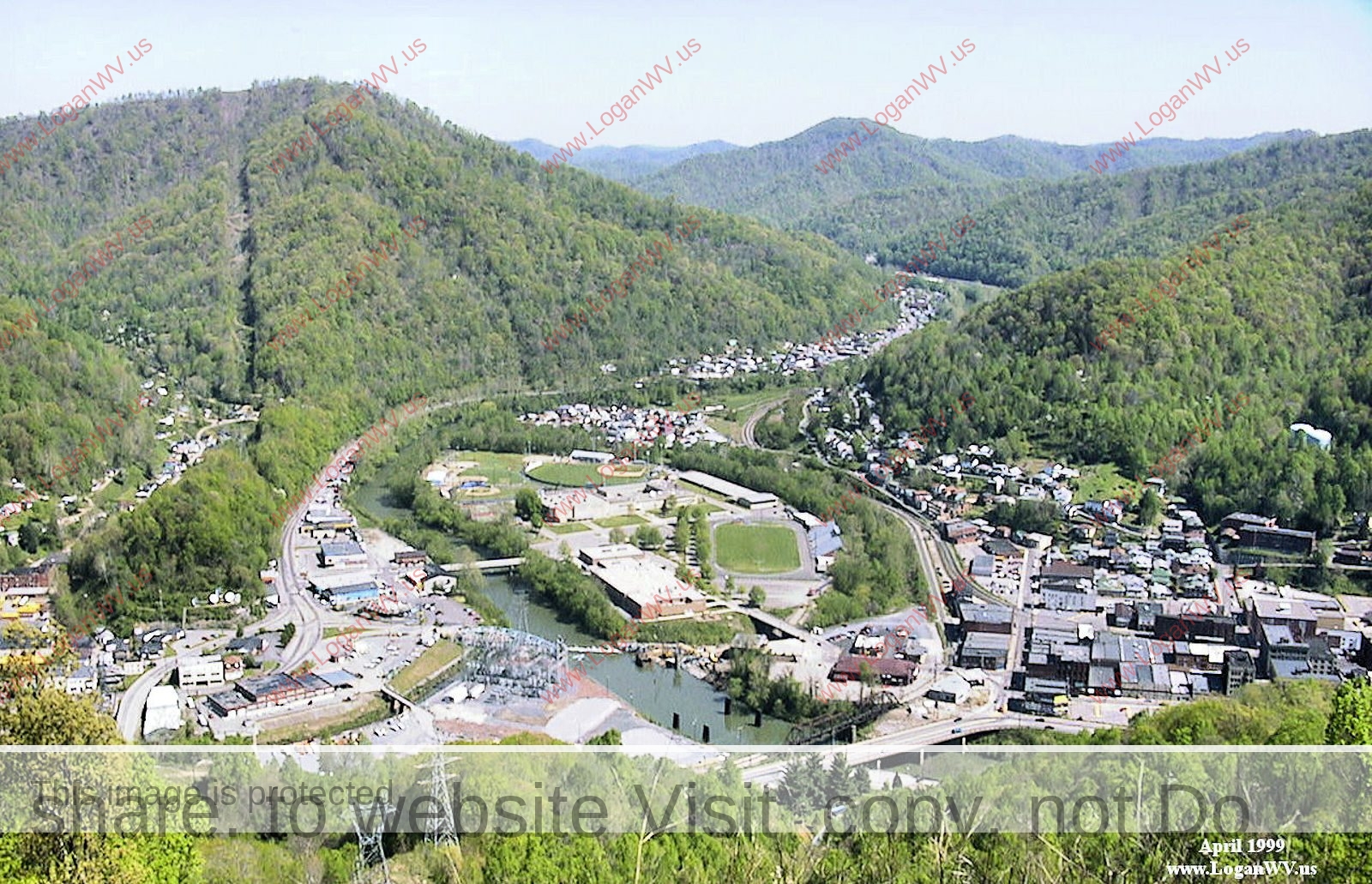
This page contains miscellaneous Logan County historical info that didn’t quite fit anywhere else.
The Old Courthouse Bell at Chief Logan Park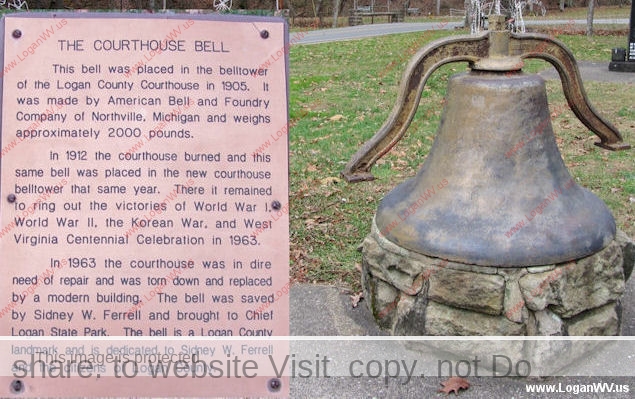
Wayne Worth – On the Road in West Virginia: Our 55 Counties,
Logan County Segment
******
1845 History of Logan County
From The Historical Collections Of Virginia by Henry Howe, 1845, p 35
Submitted by Dodie (Smith) Browning
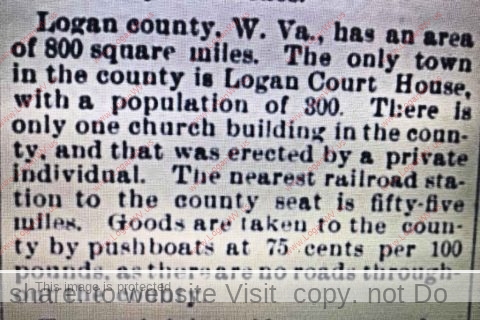
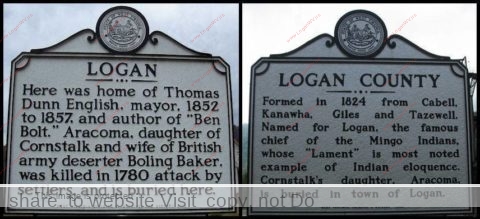
Logan was formed in 1824, from Giles, Kanawha, Cabell and Tazewell, and named from the Mingo chief. It is about 70 miles long, with a mean width of 35 miles. It is watered by Guyandotte, Tug Fork of Big Sandy and branches of the Great Kanawha. The surface is generally mountainous and the soil adapted to grazing. It is one of the largest, wildest and most sparsely inhabited counties in the state, with a population of less than 2 persons to a square mile. Pop. in 1840, whites 4,159, slaves 150; total 4,309.
Lawnsville, or Logan C.H., is 351 miles west of Richmond, in a fertile bottom in a bend of the river Guyandotte, surrounded by mountains abounding in stone-coal and iron ore. It was laid off in 1827, and contains a few dwellings only.
The destruction of the Roanoke settlement in the spring of 1757, by a party of Shawnees, gave rise to a campaign into this region of country, called by the old settlers “the Sandy Creek voyage.” This expedition was for the purpose of punishing the Indians and to establish a military post at the mouth of the Great Sandy, to counteract the influence of the French at Gallipolis with the Indians. It was composed of four companies, under the command of Andrew Lewis. The captains were Audley Paul, Wm. Preston (ancestor of the late Gov. P.,) Wm. Hogg, and John Alexander, father of Archibald Alexander, D.D., president of Princeton Theological Seminary. The party were ordered by a messenger from Gov. Fauquier to return. They had then penetrated nearly to the Ohio, without accomplishing any of the objects of their expedition. When the army on their return arrived at the Burning spring, in the present limits of this county, they had suffered much from the extreme cold, as well as hunger: their fear of alarming the Indians having prevented them from either hunting or kindling fires. Some buffalo hides, which they had left at the spring on their way down, were cut into tuggs or long thongs, and eaten by the troops, after having been exposed to the heat from the flame of the spring. Hence they called the stream nearby, now dividing Kentucky from Virginia, Tugg River, which name it yet bears. Several who detached themselves from the main body, to hunt their way home, perished. The main body, under Col. Lewis, reached home after much suffering; the strings of their moccasins, the belts of their hunting-shirts, and the flaps of their shot-pouches, having been all the food they had eaten for several days.
More history of Logan County on these other websites:
- County history and school system (pdf) courtesy of James W. Baldwin.
- 1933 Map of Logan County (pdf)
- 1910 Sanborn Fire Insurance Map of Logan, West Virginia
- History of the city of Logan, W. Va. 1823-1916 by George Thomas Swain
- LOC 1915 Logan County coalfield map
- History of WLOG
- History of WVOW
- McCormick’s Place in the History of Logan County – Page 1 (PDF)
Page 2 (PDF) - Stirrat, WV
- Logan County history by Robert Y. Spence
The content on this page is for educational purposes and is used in accordance with the Fair Use Law (Per Title 17—United States Code—Section 107).