Courtesy of Christine Hall
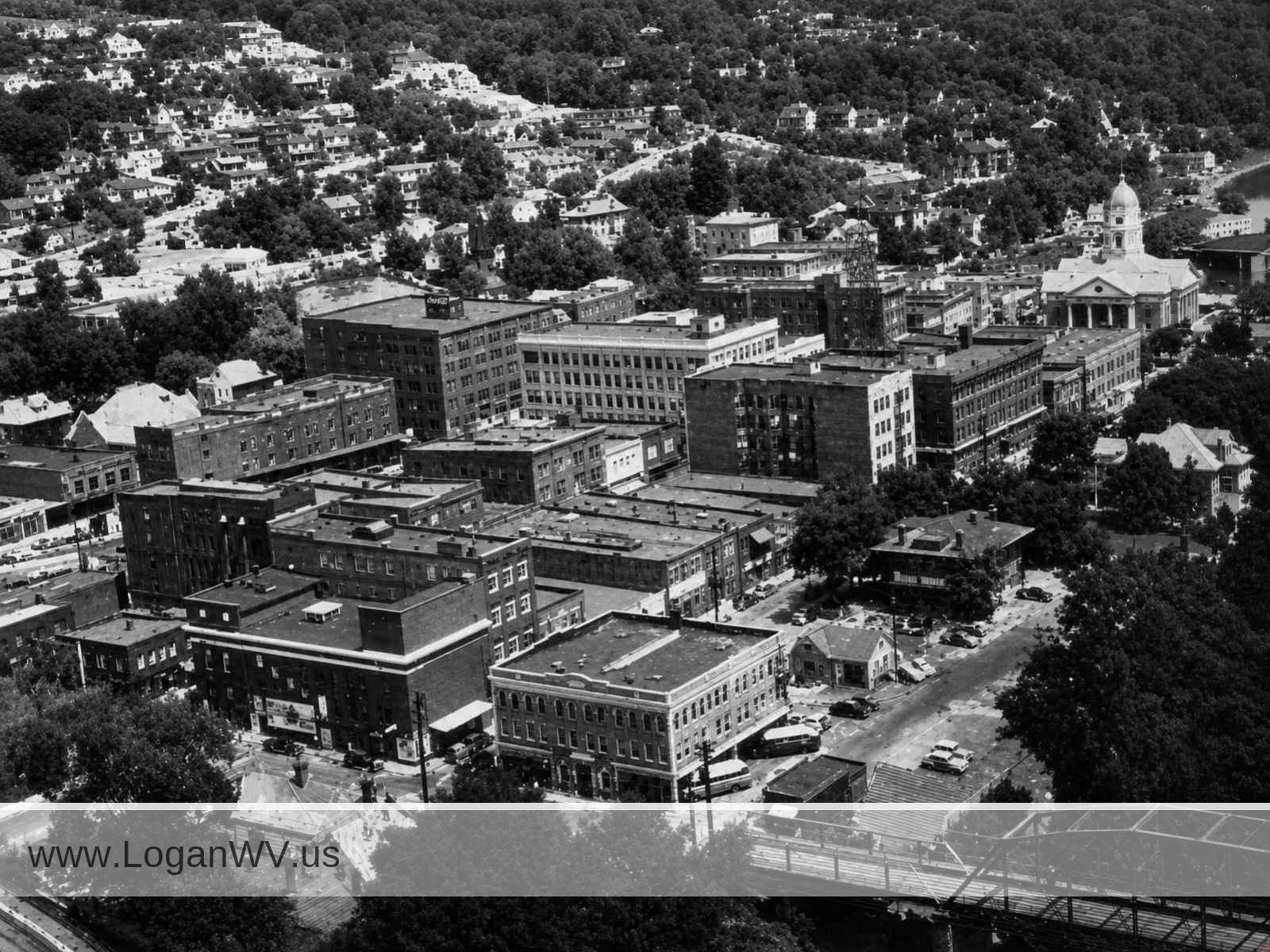
The beginning of Logan County is a picture of uneducated men setting out into a strange country as pioneers; courage and a will to win being their only tools.
The history of this county dates back to the French and Indian War. William Baker, a deserter from General Braddock’s army, was taken prisoner in Ohio by a tribe of Shawnee Indians whose chief, Cornstalk, decided to make him run the gauntlet. Tradition has it that Aracoma, the young daughter of Cornstalk, persuaded her father to spare the captive’s life and put him in their tribe. Later Baker married Aracoma, who became a princess of her race. In 1765 they started for the Kanawha valley to make their home; but they left the site and went up Coal River, across the valleys and mountains, down Dingess Run near the Guyandotte River, finally making camp on what is now known as Hatfield Island.
They lived in perfect happiness for many months tilling the soil and killing wild game for their meat. In 1777 an alliance was formed between the British government and the Indian tribes north of Ohio. It was the duty of the Indians on the Guyandotte to annoy and destroy frontier settlements. There were skirmishes between the Indians and whites for decades. The last stand of the Indians against the Virginians in this section was made at the present site of Logan, in October, 1792.
In 1799 William Dingess started the first settlement. He built his home near the present site of the court house and was so pleased with his surroundings that he encouraged friends and acquaintances to join him.
The population increased very rapidly and in 1824 Logan County was created from parts of Giles, Tazewell, Cabell, and Kanawha Counties. In choosing a name to give the new county, then comprising all of the present Logan, Mingo, and Wyoming Counties, the general assembly honored a red foeman, Logan, the Mingo chief.
The county seat was then known as “The Islands.” In 1827, the name became Lawnsville; in 1852, upon the request of Dr. Thomas Dunn English, the first mayor, the Virginia Assembly changed this name to Aracoma. Finally, in 1907, because the post office established there for years had been known as Logan Court House, the legislature of West Virginia chartered the city under the name of Logan.
SCHOOLS
The first school house in the county was erected by Peter Dingess upon the ruins of an Indian lodge on the Big Island. In that log cabin the children were taught “readin’, writin’, and spankin’.” Lewis B. Lawson erected a log house near the mouth of Dingess Run for a school building. There George Bryan taught the children, assisted by a Mrs. Graves from Tennessee, wife of a Methodist circuit-rider. Shortly after Mr. Lawson built this school house, his brother James built another on his land at the forks of Island Creek. After the passage of the free-school act by the general assembly of Virginia, the people of Aracoma and Dingess Run built a school building by the Big Rock in the narrows above Bill Ellis Hollow. The Reverend Mr. Totten, a popular Southern Methodist circuit-rider, taught in that school until the Civil War, at which time he marched away and of Aracoma and Dingess Run built a school building by the Big Rock in the narrows above Bill Ellis Hollow. The Reverend Mr. Totten, a popular Southern Methodist circuit rider, taught in that school until the Civil War, at which time he marched away and never returned. In these schools there were no uniform rulings. Each teacher followed his own ideas; each pupil studied what he pleased or what he could. One was considered sufficiently educated when he had finished McGuffey’s Reader and Ray’s Arithmetic.
RELIGION
The first settlers inherited the religion of their ancestors. There was no incentive to read books other than the Bible. More truly than most men they could say, “I will lift up mine eyes unto the hills, from whence cometh my help.” Apparently the first preacher to enter the valley was Bishop Francis Asbury. Carrying aloft the banner of the Methodist faith, he traveled through Logan County in 1800. Probably this is the reason the Methodist Church was the first to be organized here. The earliest record of a church building in the county gives the location as being on the east side of the Guyandotte River, one half mile below the town of Wilbur, near the home of William Hinchman. No records are available as to who the first minister was, but tradition records that the Reverend Mr. Asters of the Methodist Episcopal Church was early in the field. Most of these men were itinerant preachers.
THE COMING OF THE COAL INDUSTRY
The early inhabitants had long been accustomed to using coal for domestic purposes, but they had never seemed to realize that it would some day cause a complete industrial, social, and political revolution in the valley. There was an immense demand for this mineral, and knowledge that the upper valley had an almost inexhaustible supply soon reached the outside world.
Lines of steel crept slowly forward from the western terminus of Huntington, and on September 9, 1904, the first train consisting of one engine and four cars was driven into the excited city of Logan, in which a great celebration was staged.
Island Creek Coal Company was organized in 1902, and actual production and shipment of coal started in the fall of 1904.
The early inhabitants had long been accustomed to using coal for domestic purposes, but they had never seemed to realize that it would some day cause a complete industrial, social, and political revolution in the valley. There was an immense demand for this mineral, and knowledge that the upper valley had an almost inexhaustible supply soon reached the outside world. Lines of steel crept slowly forward from the western terminus of Huntington, and on September 9, 1904, the first train consisting of one engine and four cars was driven into the excited city of Logan, in which a great celebration was staged. Island Creek Coal Company was organized in 1902, and actual production and shipment of coal started in the fall of 1904.
The Gay Coal and Coke Company was organized in 1903, and was capitalized at $50,000. On Thanksgiving day in the year of 1904 the Island Creek Company mined and shipped 500 tons of coal, and it has continued shipping ever since.
The sudden appearance of a number of coal companies called for improved means of transportation; the companies encouraged the building of railroads on their property. Roads, also, were constructed through the influence of the operators.
With the new industry and improved means of transportation came an almost breath-taking increase of population. In 1900, the population of Logan County was 6,955, by 1910 it had doubled, and by 1930 it was 58,153. As most of these people lived in unincorporated towns, the coal companies had to assume the responsibility of law enforcement, school facilities, churches, amusement halls, and other community activity.
1900 TO 1940
If Rip Van Winkle had fallen asleep in 1900 on one of the mountains and awakened forty years later, his experiences would be as strange as those related in Irving’s story.
During these years a village of four hundred inhabitants has grown into a city of five thousand. In 1907, the name was changed from Aracoma to Logan. The unpaved streets with their stepping stones lined with board or cinder sidewalks had, by 1915, through the use of brick and cement assumed the appearance of city streets. The scattered frame houses have given way to beautiful brick homes and residences.
The new buildings are equipped with electricity, purified running water, gas, and telephone. Two general stores have been supplanted by numerous specialty shops, warehouses, and chain stores. Gone is the old Buskirk Hotel which served as a shelter for travelers. Visitors to the city are now accommodated by two modern fire-proof hotels. Drug stores and pool rooms appeared and furnished meeting places for the town idlers. Further amusement is contributed by the two theatres. Three banks have organized, their combined capital being, in 1924, $350,000; combined surplus $330,371; and combined assets $6,331,690.
Such changes were accompanied by better means of transportation. Days of travel by push boat and horseback disappeared with the coming of the railroad. Even this improvement left much to be desired. People still recall with shudders their experiences on the passenger train between Huntington and Logan. Prescribed formula for taking the jerky seventy-mile trip was to enter a trance as soon as seated and trust to Providence that no sticky-fingered youngster would bring back consciousness until the trip was over.
It was not until 1921 that graded roads made it possible for the citizens to boast that they had driven to Huntington and back in one day. However, by 1928 hard-surfaced roads had brought the cities within an hour and forty-five minutes of each other. Today state highways give the people of Logan easy access to every section of the state and nation.
What of the cultural life of the city? Fear that they might be called “hill-billies” has made the men and women strive to keep up with modern progress. Clubs have been formed for the purposes of bringing noted speakers to the city, encouraging social studies, and stimulating the reading of good books. It was through the work of such organizations that the city library was established in 1927.
Development along other lines created a demand for better schools. The movement to establish a high school in Logan originated at a mass meeting held at the Court House in March, 1911. After prolonged discussions of the benefits to be derived from such a school, it was voted that the question should be submitted to the people at the April election. This election proved that the citizens were almost unanimously in favor of providing better educational facilities in the city and county.
In 1911, the Board of Education employed W. W. Hall as district supervisor. F. O. Woerner was appointed principal for the high school, which was organized in what is now known as the Central Graded Building on August 28, 1911. The sixteen pupils enrolled were taught English I, Latin I, Algebra I, General History, Bookkeeping, Arithmetic, Physical Geography, and Spelling by Mr. Woerner. The school was classified as a third-rate high school. It was not until 1914 that the school offered for the first time a standard four-year high school course and was classified by the state authorities as a first-class high school.
During the years 1914-1915, the Junior High School was constructed and first occupied by Logan High School in the fall of 1915. More than one hundred students were enrolled that fall at the new building. Further evidence of the increasing interest in education is revealed by the fact that two new buildings have been built in the past two years. One is the 21-room building located on the hill and the east end school building in the east end of town. The old junior high school building is occupied by the Central Grades now.
By 1921 enrollment had increased to the point where it was necessary to have another building. At this time it was decided to organize the schools on the 6-3-3 plan. At the same time the curriculum was extended so that the student might receive either a college preparatory, general, or commercial certificate. In 1930 the school became a member of the North Central Association of Secondary Schools and Colleges. These advantages have increased the enrollment to nine hundred and the graduating class to two hundred and twenty-five.
Thus we leave Logan County in 1940 as one of the wealthiest and most progressive sections of West Virginia. Its population being alert and eager to keep up with modern civilization, there is no reason why the county will not continue to become more and more a vital part of the state and nation.