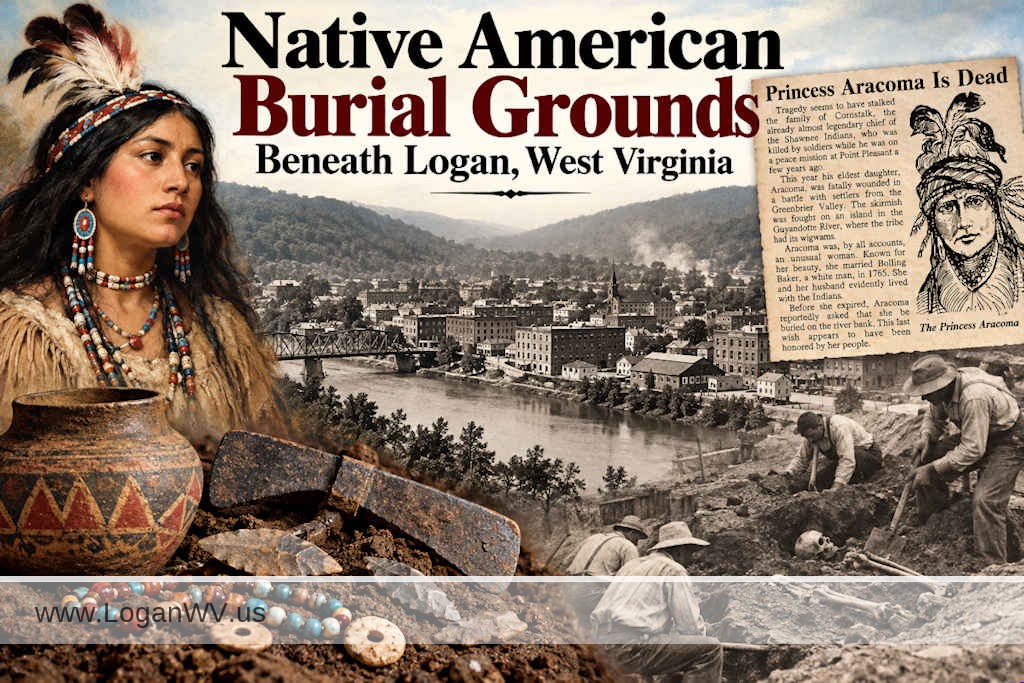
Long before Logan, West Virginia, became a center of government, commerce, and coal mining, Native American people lived throughout the Guyandotte River Valley. Generations of people made their homes in this region, leaving behind traces of their lives, communities, and burial traditions.
Over the years, excavations for buildings, streets, and utility lines in downtown Logan have uncovered human bones, skeletal remains, and artifacts believed to be associated with Native American burials. These discoveries span more than a century and include eleven skeletons reportedly exhumed during construction of a home in 1895, a 1921 newspaper report describing human bones and a tomahawk, additional remains discovered in 1938, and a major recovery of remains at the former Pioneer Hotel site in 2011.
Together, these accounts provide important evidence of a Native American presence in the area long before the modern town developed. They also raise questions about the extent of the burial grounds, the identities of the people buried there, and how their history can be preserved.
Logan Was Once Known as Aracoma
The history of Logan’s Native American heritage is reflected in the name the community once carried.
In 1852, the town was incorporated as Aracoma, in honor of the Native American princess remembered in local tradition. The community was officially renamed Logan in 1907.
The name Aracoma remains an important part of Logan County’s cultural history. However, details about the princess’s life and death have been passed down through historical accounts and local tradition, and not all have been independently verified.
A historic newspaper clipping titled “Princess Aracoma Is Dead” recounts one version of her story. The article describes Aracoma as the eldest daughter of Cornstalk, whom it identifies as a prominent Shawnee chief killed by soldiers while on a peace mission at Point Pleasant.
According to the newspaper, Aracoma was fatally wounded during a battle with settlers from the Greenbrier Valley. The article states that the skirmish took place on an island in the Guyandotte River where her tribe had its wigwams.
The account also describes Aracoma as a woman known for her beauty and reports that she married a white man named Bolling Baker in 1765. It says that she and her husband apparently lived with Native Americans.
The newspaper further relates that, before her death, Aracoma asked to be buried on the riverbank. The article concluded that her final wish appeared to have been honored by her people.
These details should be understood as the newspaper’s version of the Aracoma story, rather than as independently established facts. Nevertheless, the account illustrates how the princess became part of the region’s historical memory and why her name was chosen for the town in 1852.
Historical image caption: “Princess Aracoma Is Dead” — A newspaper account recounting the local tradition surrounding Princess Aracoma, whose name was given to the town when it was incorporated in 1852.
Eleven Native American Skeletons Discovered in 1895
One of the earliest reported discoveries of Native American remains in downtown Logan occurred in 1895, during construction of a home for Judge John B. Wilkinson and his wife, Rebecca Chafin Wilkinson.
According to the historical information associated with the property, eleven Native American skeletons were exhumed during construction of the home.
The house later became the Harris Funeral Home, which served Logan County from 1908 until 1966.
The discovery of eleven skeletons at one location is significant when considered alongside later reports of human remains found elsewhere in downtown Logan. It raises the possibility that Native American burials extended across a substantial area, although the full boundaries of any burial ground have not been established.
The available information does not conclusively establish the age of the skeletons, the identities of the individuals, or the precise extent of the burial area. An original newspaper account, property record, or archaeological report documenting the 1895 discovery would help researchers establish those details more firmly.
Even with those unanswered questions, the reported discovery is an important part of Logan’s history and provides a starting point for understanding the archaeological evidence found in subsequent decades.
A 1921 Newspaper Reports an Old Indian Burial Ground
A particularly valuable contemporary account appeared in a 1921 newspaper article titled “Old Indian Burial Ground Unearthed.”
The article reported that workers had uncovered human bones and an Indian tomahawk on a lot being prepared for the construction of a large building for Dr. S. A. Draper on Stratton Street.
According to the newspaper, several doctors examined the bones and pronounced them to be human. The discovery led to the theory that the area had been used as a Native American burial ground many years earlier.
The article also reported that a complete tomahawk had been found and was then in the possession of a man named Bob Stratton.
A crowd gathered to watch the excavation, and some spectators hoped that additional discoveries would be made. The newspaper noted that people were even collecting Indian souvenirs at the site.
This account provides a valuable glimpse into how the discovery was understood at the time. It also supplies names and a street location that may help researchers identify the property through historic maps, city directories, property records, and other newspaper reports.
The article does not establish the age of the remains or identify the people whose bones were uncovered. However, it documents the discovery as it was reported in 1921 and adds to the evidence that Native American remains were being found during the development of downtown Logan.
The Aracoma Hotel and the Princess Aracoma Tradition
Other discoveries of human remains have been associated with the Aracoma Hotel and nearby properties.
Accounts of excavation for the hotel’s basement describe graves and skeletal remains uncovered during construction. In 1915, a grave reportedly discovered in the 100 block of Stratton Street attracted attention.
The grave was described as approximately eight feet deep and contained the skeletal remains of a female believed to be Native American. Buckhorn beads were reportedly found around her neck.
The discovery became associated in local tradition with Princess Aracoma. However, the identity of the woman was never conclusively established.
It is important to distinguish the reported discovery of a grave from the traditional identification of its occupant. The burial may have contributed to the stories surrounding Aracoma, but the available evidence does not prove that the woman was the princess herself.
The account remains an intriguing part of Logan’s history because it connects the community’s traditions with physical discoveries beneath its streets. It also illustrates why historical claims about the identity of human remains should be approached carefully.
The 1938 Discovery Near Cole and Stratton Streets
Another significant discovery occurred in September 1938, when city employees excavating for a water line near the southwest corner of Cole and Stratton streets uncovered what a contemporary newspaper described as a substantial number of Indian remains.
The report described bones from arms, legs, and feet, along with skull fragments, beads, and a tomahawk. Two jawbones were also found, one belonging to a young child and the other to an adult. The teeth were reportedly remarkably well preserved.
The newspaper suggested that the workers had encountered part of an old Native American burial ground believed to extend through the area near the Aracoma and Pioneer hotels.
Many of the remains were reportedly found only a few feet below the street surface. Flat stones discovered above or around portions of the burials may have been associated with the construction or protection of graves, although their purpose has not been conclusively established.
The 1938 discovery adds to the earlier newspaper account from 1921. Both reports describe human remains and artifacts uncovered during excavation in downtown Logan.
Considered alongside the eleven skeletons reportedly exhumed in 1895, these accounts suggest that Native American burials were present at multiple locations in the developing town.
The 2011 Discovery at the Former Pioneer Hotel Site
More than a century after the earliest reported discoveries, another major find brought Logan’s Native American burial history to renewed public attention.
On January 31, 2011, construction workers uncovered Native American skeletal remains at the site of a planned state office building in downtown Logan, where the former Pioneer Hotel had stood. Additional discoveries followed as work continued.
An account published by Indian Country Today in 2012 reported that 44 sets of American Indian skeletal remains had been recovered during the project and associated discoveries over the following months.
Representatives of Native American communities, including the Seneca Nation of Indians and the Eastern Shawnee, were involved in addressing the discoveries and arranging for appropriate reburial.
The findings interrupted construction and raised important questions about how suspected burial grounds should be treated when modern development takes place.
Unlike the earlier discoveries preserved primarily through newspaper reports, the 2011 recovery received broader attention and involved consultation with tribal representatives. It demonstrated that the Native American history beneath downtown Logan was not merely a matter of local legend or old newspaper stories.
Human remains were still being encountered during modern construction, underscoring the importance of archaeological investigation, respectful treatment, and cooperation with descendant communities.
What Do These Discoveries Tell Us?
The discoveries reported in 1895, 1921, 1938, and 2011 reveal a recurring pattern: development in downtown Logan has repeatedly exposed evidence of earlier Native American burials.
The reports are valuable because they preserve details that might otherwise have been lost, including excavation locations, objects found, and the names of people connected with the discoveries.
However, several questions remain unanswered. The precise boundaries of the burial areas are uncertain, the dates of many burials have not been established, and the available accounts do not conclusively identify the Native American communities associated with every discovery.
Artifacts such as tomahawks and beads can provide clues about the past, but they cannot, by themselves, establish the identity or age of a burial. Those questions require reliable archaeological documentation and, where appropriate, consultation with descendant tribal communities.
The discoveries should also be treated with respect. Human remains are not simply historical curiosities; they belonged to individuals who had families, communities, and lives of their own.
Preserving Logan’s Native American Heritage
Logan’s history includes its courthouse, historic businesses, coal-mining heritage, and the generations who built the modern community. It also includes the Native American people who lived in the Guyandotte River Valley long before the town was incorporated.
The name Aracoma, adopted when the town was incorporated in 1852, preserves a connection to the region’s Native American history. The official renaming of the community as Logan in 1907 marked another chapter in the town’s development, but it did not erase the history that came before.
The eleven skeletons reportedly uncovered in 1895, the 1921 newspaper account of bones and a tomahawk on Stratton Street, the 1938 water-line excavation, and the 2011 recovery of Native American remains are important pieces of this historical record.
Preserving this history means keeping original newspaper reports available, documenting known discoveries, consulting appropriate tribal representatives, and ensuring that future construction projects treat suspected burial sites with care and comply with applicable laws.
Historic newspapers, property records, maps, and archaeological documentation may help researchers establish the locations and circumstances of discoveries that were only briefly described at the time.
The history of Logan is not only the story of the town that grew above the ground. It is also the story of the people who lived in this region and were laid to rest here long before Logan Court House became a settlement. Their history deserves to be remembered, documented, and treated with respect.
Historical Sources and Related Reading
- “Old Indian Burial Ground Unearthed” (1921): The contemporary newspaper clipping documenting the discovery of human bones and a tomahawk on Stratton Street.
- “Princess Aracoma Is Dead”: The historical newspaper clipping recounting one version of the Princess Aracoma tradition.
- “Graveyards Abounded Under Logan Streets”: Read the article on LoganWV.us.
- “Finding Princess Aracoma”: Read the article on LoganWV.us.
- “Repatriation of Remains a Lengthy Affair in West Virginia”: Read the report at Indian Country Today.
*This article was created with the help of ChatGPT.
A good story, especially the ‘treat with respect’ aspect. Someday a sketch of the full burial site, overlaid by a current street map, may be attempted.