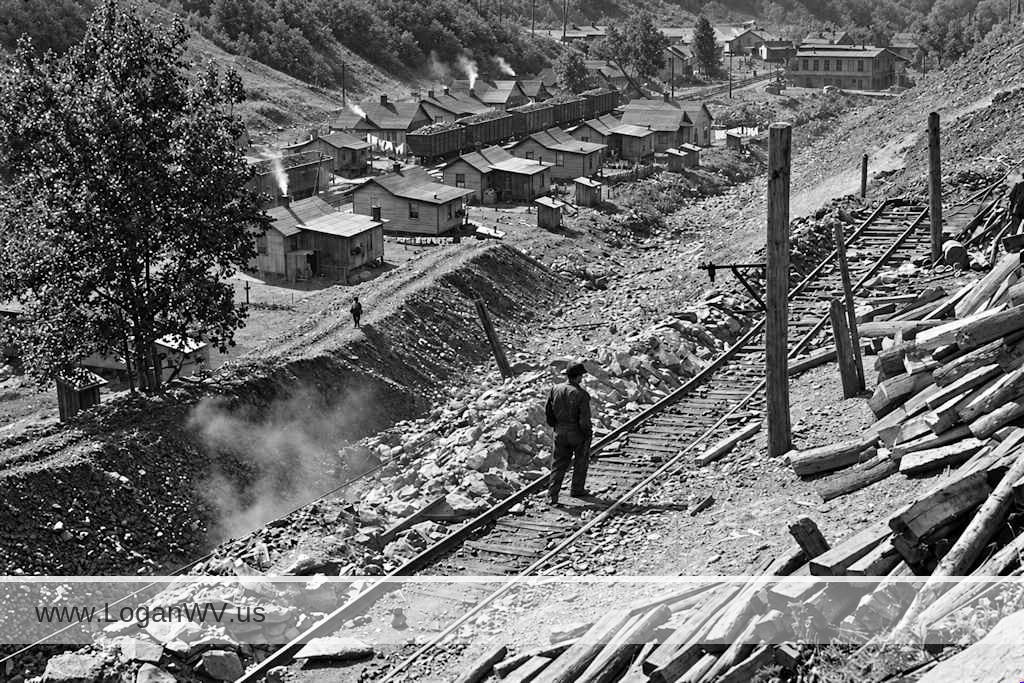
From Coal Boom to Bust: How Mechanization Changed Logan County, West Virginia
The rise of the coal industry brought jobs, prosperity, and new communities to Logan County. But as machines replaced manual labor, thousands of miners lost their livelihoods, leaving an economic legacy that continues to shape southern West Virginia.
The Coal Boom Comes to Logan County
At the turn of the twentieth century, Logan County, West Virginia, stood on the threshold of a remarkable transformation. Beneath its mountains lay vast deposits of bituminous coal, a valuable resource needed to fuel America’s growing industrial economy.
Although the region’s coal deposits had been known for years, transporting coal to distant markets was difficult. That changed in 1904, when the railroad reached the city of Logan, opening the coalfields to large-scale commercial development.
Coal companies quickly moved into the region. Island Creek Coal Company, organized in 1902, began shipping coal in 1904. Other operators followed, opening mines, building railroad connections, and establishing company towns throughout the county.
The result was an extraordinary economic and population boom. Logan County’s population grew from 6,955 in 1900 to 14,476 in 1910 and reached 71,391 by 1950. Communities that had once been small rural settlements became busy mining towns supported by coal production.
Coal was no longer simply a local resource. It had become the foundation of the regional economy, connecting Logan County to industrial centers throughout the nation.
Recruiting Miners From Across America and Overseas
The rapid expansion of the coal industry created an enormous demand for labor. Local communities could not supply all the workers needed to operate the growing number of mines.
Coal companies responded by recruiting workers from other states and foreign countries. Labor agents sought men willing to undertake the difficult and dangerous work of mining coal, often promising steady employment and better economic opportunities.
Workers arrived from throughout Appalachia and other parts of the United States. Immigrants from Europe also came to West Virginia, bringing their languages, customs, religious traditions, and family histories. African American workers, including people moving north and west from the segregated South, also contributed to the region’s industrial workforce.
These men and their families helped build the coalfield communities that became central to West Virginia’s identity.
Company towns grew around mines, with houses, stores, schools, churches, and other facilities serving the expanding population. Local businesses benefited from the wages miners earned, while railroads and related industries created additional employment.
But the system had serious disadvantages. In many company towns, the coal operator controlled housing and other necessities, leaving families heavily dependent on the same company that employed them. When mines closed or employment declined, the entire community could suffer.
Coal brought opportunity, but it also created an economy in which the fortunes of thousands of families depended on a single industry.
The Miner and His Work
For generations, coal mining was physically demanding work requiring large crews of men.
Underground miners drilled into coal seams, cut the coal loose, used explosives where appropriate, loaded the broken material, and transported it toward the surface. Other workers maintained equipment, supported mine roofs, repaired machinery, and moved coal through the mine.
The industry supported far more people than those working underground. Railroad employees, mechanics, carpenters, storekeepers, and other workers depended on the mines for their livelihoods.
In communities throughout Logan County, a successful mine could mean steady employment for hundreds of families. Miners’ wages supported local merchants, restaurants, schools, churches, and civic organizations.
Coal also helped define the region’s social and political history. Dangerous working conditions, disputes over wages, and conflicts over union recognition led to bitter struggles between miners and operators.
West Virginia became a major center of the American labor movement. Miners organized to demand better wages, safer working conditions, and the right to bargain collectively.
Their work was difficult and dangerous, but coal mining provided a living for generations of families who helped build the state’s economy.
For many, it was more than an occupation. It was a way of life.
The Machines Begin to Arrive
As coal companies sought to increase production and reduce costs, they began introducing machinery into their mines.
Early mechanical innovations included machines that cut into coal seams, reducing the amount of manual labor required to prepare coal for removal. Electric locomotives and improved haulage systems gradually replaced older methods of moving coal through underground workings.
Initially, some machinery helped miners perform their jobs more efficiently. But the development of mechanical loading equipment brought a much more consequential change.
Loading coal by hand was exhausting work. Miners used shovels to transfer broken coal into mine cars, often working in cramped conditions. Mechanical loaders could move far more coal in less time and with fewer workers.
Logan County played an important role in this transition.
In 1920, the Gay Coal and Coke Company in Logan County installed the first Joy loader on caterpillar treads used in the United States. The machine represented a major step toward mechanized coal production.
As these machines improved, other companies adopted them. By the late 1940s and early 1950s, mechanization was advancing rapidly throughout the state’s coalfields.
The consequences for employment would be enormous.
When Machines Replaced Men
The scale of the transformation can be seen in a few remarkable statistics.
In 1935, only 2% of West Virginia’s coal was loaded mechanically. By the mid-1950s, nearly all of the state’s coal was being loaded by machine.
This change meant that coal companies could produce substantially more coal without hiring a proportionate number of additional workers.
A task once requiring a crew of men with shovels could increasingly be performed by a machine operated by a much smaller crew. Continuous mining machines eventually combined cutting and loading operations, further reducing the need for manual labor.
From the operators’ perspective, the advantages were clear. Mechanization increased productivity, lowered labor costs per ton, and allowed companies to remain competitive.
For miners, however, the benefits came at a tremendous cost.
As machinery took over work once performed by hand, companies needed fewer employees. Some miners found other jobs within the industry, but many were laid off or forced to seek employment elsewhere.
Coal production could remain high even as employment fell. The industry was becoming more productive, but it no longer needed the enormous workforce that had once sustained the coal towns.
The same technological progress that helped make mining more efficient also undermined the economic foundation of many mining communities.
The Human Cost of Progress
The displacement of miners was especially painful because coalfield communities often had few alternative sources of employment.
A miner who had spent decades working underground possessed valuable experience, but those skills did not necessarily translate easily into jobs in other industries. Older workers faced the prospect of starting over late in their working lives, while younger men found fewer opportunities to follow their fathers into the mines.
Some families left West Virginia to seek work in Ohio, Michigan, Pennsylvania, and other industrial states. Others remained, hoping that another mine would open or that employment would return.
When a mine closed, the consequences extended far beyond the workers who lost their jobs.
Local stores lost customers. Businesses struggled to survive. Houses became vacant, and property values sometimes declined. Schools and other community institutions faced additional pressures as families moved away.
The loss of employment could set off a chain reaction: fewer jobs led to population decline, population decline weakened local businesses, and a shrinking economy made it harder to attract new employers.
For many communities, this was the beginning of a long period of economic uncertainty.
Mechanization Was Not the Only Cause
Although mechanization was a major factor in coalfield job losses, it was not the only one.
Changes in national energy markets, competition from other coal-producing regions, mine closures, improvements in transportation, and the growing use of natural gas all affected the industry’s employment needs.
Mining technology also continued to evolve, allowing companies to extract coal more efficiently with smaller crews.
These developments reinforced one another. Even when demand for coal remained strong, companies could produce it with far fewer workers than in earlier decades.
This distinction is important. The decline in mining employment did not always mean that coal had become unnecessary or that production had stopped. It often meant that the industry had changed in ways that required less human labor.
For communities built around employment-intensive mining, that difference was critical.
The coal was still there. The machinery could still extract it. But the jobs that had supported generations of families were disappearing.
A Lasting Legacy in Logan County
The economic effects of declining coal employment continue to influence Logan County and southern West Virginia.
For decades, coal helped support local businesses, families, and public institutions. When the industry reduced its workforce, many communities struggled to replace the wages and economic activity that mining had provided.
Population loss, fewer employment opportunities, and the departure of younger residents have contributed to long-term challenges in parts of the region.
The effects vary across communities, and West Virginia’s economic difficulties have many causes. Nevertheless, the history of mechanization helps explain why the loss of coal jobs has had such a lasting impact.
Coal was not simply another industry. In many places, it was the principal source of employment and the center of community life.
When that foundation weakened, residents had to find new ways to support their families and preserve their communities.
The challenge facing Logan County and other coalfield communities is not merely to remember the past, but to build an economic future that offers younger generations the opportunities their parents and grandparents once found in mining.
That means developing employment beyond a single industry while preserving the region’s history, skills, traditions, and cultural identity.
Remembering the Men Who Built the Coalfields
The history of coal mining in Logan County is a story of extraordinary change.
The arrival of the railroad opened the region to industrial development. Coal companies recruited workers from across America and overseas. Miners labored underground, often under dangerous conditions, to produce the fuel that powered the nation’s factories, railroads, and industries.
Their work helped transform a rural mountain county into an important coal-producing region.
But technological change brought a different future. Machines increased production while reducing the need for human labor, leaving thousands of miners and their families to confront unemployment, relocation, and economic uncertainty.
The consequences are still felt today.
The history of Logan County’s coalfields should therefore be remembered in its entirety: the boom that created communities, the workers who built the industry, the machines that transformed mining, and the families who bore the cost when employment disappeared.
These miners were more than numbers in production reports. They were fathers, sons, husbands, neighbors, and community members whose labor helped build West Virginia and fuel America’s industrial growth.
Their stories deserve to be preserved for future generations.
*This article was created with the help of ChatGPT.
You may also enjoy: Coal Miners – The Heroes of Appalachia
LoganWV.us is dedicated to preserving the photographs, memories, and history of Logan County, West Virginia, and the people who made it what it is today.
Historical Sources
- West Virginia Encyclopedia: Logan County
- West Virginia Encyclopedia: Joy Loading Machine
- West Virginia Encyclopedia: Coal Mine Mechanization
- West Virginia Department of Arts, Culture and History: From Shovels to Machines
- LoganWV.us: History of Logan County from the 1940 Logan High School Yearbook
My family goes back generations in Logan coal mining past my grandfather James Watts and his 9 kids with my dad being the 2nd from the youngest
Respect and honor to all from Logan