By Dwight Williamson
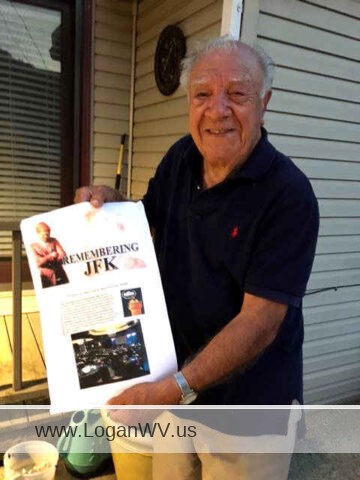
Editor’s Note: This is the first of a two-part series involving the amazing life of a former Logan Countian, who, like so many other former Loganites over the years, managed not only to prosper and make a name for himself in American history, but also to make Logan County proud in doing so. His story, like many others still to be relayed, should serve as a beacon of hope for those young “stars” in southern West Virginia who hope to shine brightly someday.
Growing up in the coal fields of Logan County nowadays is certainly much different from the days of yesteryear when most people didn’t even lock their doors when they went to bed at night. Of course, a declining population and a lack of jobs, particularly coal mining employment, has been a major problem in the declining economics of the Appalachians for many years. Throw in the drug epidemic that has virtually destroyed many families, and it is little wonder why there is major concern for the future of southern West Virginia and our decaying and drug-ridden society.
Although the outlook may sometimes appear bleak for our younger generation, I think it is very important for them to realize just how successful one can be by them taking a historical look at some of the people who came from various parts of Logan County and went on to have very notable careers.
Out of this rural county, which has seen the world-renowned bloodshed of the Hatfield-McCoy Feud and the Battle of Blair Mountain, has risen many stars. From Hollywood male and female movie actors to pro football and baseball stars, to a nine-year world heavyweight boxing champion, Logan County has produced numerous people who have made their marks in American society.
Long before Landau Eugene Murphy stole the hearts of Logan Countians, there were other talented musicians and singers who came from the hills and hollows of Logan to present their talents on a national scale. Over the years, thousands of Logan Countians have fought in various wars and military conflicts, many returning home with honorary medals, while others came home in pine boxes.
From man’s first landing on the moon to the Olympics games, there is a direct correlation to people who have ties to Logan County. The names of many of these people cannot be found in the annals of American history, but certainly should he highlighted on the local level as “special” people who will forever be known as Loganites.
There is no better example of an immensely successful Loganite than that of an immigrant son who started out shining shoes at what he called local “whorehouses,” such as the two-story Sidebottom Hotel that stood in Deskins Addition, an area many older folks still refer to as Black Bottom.
At 85 years old, Carmelo “Mel” Cottone – who along with his only sibling, Katherine Adkins of Verdunville, was born in a two-room coal camp house without electricity or indoor plumbing at No. 20 Whitman Creek – should be recognized as Logan County’s best well-kept secret. It’s his amazing accomplishments since joining the presidential campaign of John F. Kennedy in 1960 when Kennedy visited Logan County that can only be described as “astounding.” Indeed, it is Mel Cottone’s life story which should prove as the motivation for any young person to realize that perseverance and hard work can produce near miracles, regardless of race, religion or economic background.
The son of a coal miner, Mel Cottone, known to some as simply Mel Cotton, grew up in what can be called the Italian part of Mt. Gay in a house that was located behind what is the still popular Park ‘n Eat Drive-In. “My dad bought the house in 1941 for $4,000. I don’t know where the hell he got the money,” Mel says. “I think the Scaggs’ owned the property at the time.”
From Cherry Tree to Mt. Gay, there were several Italian families, many of whose names are locally recognizable even today – Chirico, Esposito, Dress, and Piccorillio, for example. Italians came to the Appalachians from different parts of Italy, according to Cottone, who said there was a great deal of competition between the different Italian families, and that they did not always get along well. He noted that at one time the Chirico family operated four stores in the local area. Cottone spoke of other Logan Italian families he became familiar with, such as the Varrassis, Murreddus, Nollettis, Triolos and Barbers, all of whom have played important roles in Logan history. He said that his father, John Cottone, loaned Bernard Codispoti (father of Magistrate Leonard Codispoti) a wine press when Mel was just a young boy. “I don’t think he ever did get that press back,” Mel said with a laugh. “I’m actually Joe Codispoti’s godfather,” he added. “We were all close because we had to be.”
In Logan County today, religious and ethnic bigotry is fairly non-existent compared to the 1960s when Sen. John F. Kennedy brought his Roman Catholic religious tag to the political heart of the Baptist belt seeking to gain the support of Protestants, some of whom bore very close associations to the local Ku Klux Klan, a widely accepted organization that was noted for its anti-Catholic sentiments.
It was a private meeting with Ted Kennedy in 1960 that would develop into a bond with the entire Kennedy family that led to an improbable 50-year career in Washington, D.C. Mel rose into prominence as a lawyer and aide to John and Robert Kennedy, Lyndon Johnson, Jimmy Carter, John Glenn, and several others. Over the years, Cottone has been a key participant in many national and state campaigns, including those of Bill Clinton and West Virginia’s own Robert C. Byrd. In addition, he has been given several presidential appointments and has served as political strategist and advisor for many select politicians on the federal, state and local levels.
Now retired from his work in Washington, D.C., Mel and his wife, Maria, reside in Boca Raton, Florida, where Mel is still engaged in political strategy development and in advisory roles. He also has appeared in numerous speaking engagements where he has been described as a “dynamic speaker who has witnessed and participated in political history.” He also has authored two books, “The Winning Ballot, A Candidate’s Guide to Successful Campaigning” and “A Presidential First.”
Despite all of his fascinating experiences with the elite, the still vigorous Loganite has never forgotten his humble beginnings in Logan County. On a recent visit to his sister’s family, this writer became enchanted with Mel, after a family member invited me to meet with him. In separate talks with him since then, it has become abundantly clear that if there ever should be a Logan County Hall of Fame, Mel Cottone’s name should be at the top of the list.
However, to truly appreciate the life of the distinguished Mr. Cottone, one must also consider his life on a more local level. For it is truly the story of a man who went from the “outhouse to the White House.”
In the days of small community schools and when teachers were not burdened with all of the “technical” paperwork that is required today, it was a teacher (Mrs. Avis) who is given credit for instilling encouragement and confidence into the life of a young man who grew up across from a mining operation known as Mt. Gay Coal and Coke. It was this coal mine, owned by Harry Gay, that had produced the first ever load of coal hauled to nearby Logan to be transported by train in 1905.
Another mentor, who Mel has given much credit for his developing an early interest in politics, is another teacher and former mayor of Logan, Tom Orr. Orr much later would become superintendent of schools in Logan County. Orr encouraged him to pursue his interest in politics and in law. Cottone’s first taste of political success came when he was elected to Logan Senior High School’s Student Council.
As he recalls growing up near Logan, Mel has many many fond memories that bring smiles to Mel’s face. However, he also remembers the hard times that had to be endured by so many families whose lives literally depended on coal mining.
“Camello Pansera’s family lived right next to me and there was a gang of kids in that family,” Mel recalled. “I remember the terrible news of him being killed in the mines. They said his body was split in half. My family cried, and I don’t know how those kids’ mother (Angelina) was able to raise them all, but she did.”
Later on, when he was fortunate enough to visit Italy, Mel said he filmed his grandparents and other family members in southern Italy and kept the 8 millimeter film stored on a shelf in his parents’ Mt. Gay home. Even though his father had raised the framed dwelling three times, it was one of the many floods that have wreaked havoc in Mt. Gay for scores of years that washed away his film. “I know my father just could not believe that the water would ever reach the shelves where the film was stored,” said Cottone.
Although flooding has always been a problem because of the overflowing of streams that lead into the Guyandotte River such as the Mud Fork and Island Creek that converge at Mt. Gay, according to Cottone, the flooding in that area was caused by the filling in of the creeks.
“The road used to be about three or four feet from the creek when they started filling it in from the Holden Road to the Esposito store at Mt. Gay, and all the way through Black Bottom,” he recalled. “They placed junked cars in the creeks and covered them with dirt and debris, narrowing the creeks, and that led to the flooding. I don’t think we ever got flooded before people started filling in the creeks.”
The lively Cottone is quick to revive some other childhood memories: “When I was 12 years old, I used to shine shoes at beer gardens and whore houses near town. I even remember shining some of those prostitutes shoes, too,” he said with a laugh.
Besides the Sidebottom Hotel, two other locations he remembers well in Black Bottom were the Green Lantern Tavern and the Wagon Wheel. “The Sidebottom Hotel was a two-story white building,” Mel explained. “I remember the night it burned down. There was a whole bunch of girls come running out of there in their night gowns.”
The Green Lantern, which existed as far back as 1932 when a witness working there testified in the murder trial involving Mamie Thurman, was replaced by what became Anderson Wholesale in Deskins’ Addition, possibly in the 1980s. During the 1960s and ’70s, the Green Lantern was notoriously known for fights, which included stabbings and shootings.
While violence certainly was a part of growing up in Logan County during Mel Cottone’s childhood, it was the violent death of a young “American Camelot” named John Kennedy – better known to Cottone simply as Jack – that would shock the world, and send the young Loganite’s life spiraling as he then became even closer to the Kennedy families and the new president of the United States, Lyndon B. Johnson.
Dwight Williamson is a former writer for the Logan Banner and a retired magistrate for Logan County.
*Published with the author’s permission.
Articles by Dwight Williamson on this site.
- “Boots” was anything but a normal coal miner
- 1916, 1917 were especially eventful years in Logan County
- A guardian angel from 1972
- A stringent look into the history of Logan County
- Alderson helped elevate Logan to greatness
- Articles About The Murder of Mamie Thurman
- C.C. Chambers was one tough judge
- Cap Hatfield led an interesting life
- Carmello “Mel” Cottone went from Mt. Gay to the White House
- Changes in Logan during the year 1912
- City losing another historical structure
- Coal camp Christmas memories
- Death of the Hatfield brothers
- Dehue Company Store Closing
- Don Chafin and the Battle of Blair Mountain
- Early 1900s Logan was crime infused with soap opera
- Early Logan Co.: A mighty tough place to live
- Early Logan County was a ‘mess’
- Early Travel in Logan County
- English credited with discovering coal in Logan Co.
- Even without the vote, Logan women accomplished much
- Every building in downtown Logan has a story
- Finding Princess Aracoma
- Fires change course of Logan’s history
- Former baseball player from Holden barely remembered today
- Frank Hall was a legendary moonshiner
- Graveyards abounded under Logan streets
- Growing up with the Company Store
- Halloween escapades of the “Porch Sitters”
- Hatfield and Chafin clans played large role in Logan history
- History before our eyes
- Holiday Memories from the Shegon Inn
- Kathy’s story
- Life was more free when tram roads crossed the mountains
- Logan area had thriving Italian community
- Logan Co. people with national interest
- Logan County history filled with unsolved murders
- Logan County is rich with Native American history
- Logan High School almost missed being on the island
- Logan was a focal point of Tommy gun sales
- Logan’s Boulevard has a storied history
- Longing for the good old days
- Man, W.Va., holds 100 years of memories
- Mel Cottone recalls growing up in Logan
- Mel Cottone rubbed elbows with presidents
- Mid-1930s were a wild time in Logan County
- Monumental efforts gave us our ‘Doughboy’
- Neighbors
- Old newspaper articles tell of Battle of Blair Mountain
- Random thoughts on Logan history and people
- Recalling one of the worst floods in Logan
- Recollections of old stores and “filling” stations
- Remembering some of the coal camp communities
- Remembering the Community of Holden 22
- Searching for the Holland grave
- Since Mamie Thurman’s Day, Has Logan Changed?
- Some early history of the Logan area
- Some find their life goals at home; others move away
- Spiritually reuniting Logan’s pioneer couple
- Tennis Hatfield and the Blue Goose Saloon
- Tennis Hatfield’s rise and fall is a story to remember
- The Civil War in Logan County
- The Creation of Logan County
- The end of the Hatfield political dominance
- The historic cemetery in Logan
- The journey of Logan’s Woman’s Club
- The legendary Don Chafin
- The little town at the mouth of Buffalo Creek
- The man responsible for the creation of Mingo County
- The Midelburg family history in Logan
- The murderous ’30s
- The old custom of ‘funeralizing’
- The porch sitters
- The story of Tennis Hatfield, son of Devil Anse
- The story of the Chirico family restaurants
- Those were the good old days of Logan
- Today’s kids don’t know the freedom we had
- We were ‘poor,’ but I didn’t care and still don’t
- WV’s oldest barber shop is in Logan